RadarSim
RadarSim is a radar simulator I wrote to study how a surveillance or fire-control radar actually behaves: when a target is first detected, why a track is lost in a hard turn, how much a self-screening jammer hides an aircraft, what sea clutter does to a sea-skimming missile. It runs the physics look by look, shows the result the way a radar display would, and lets you change the radar while it runs.
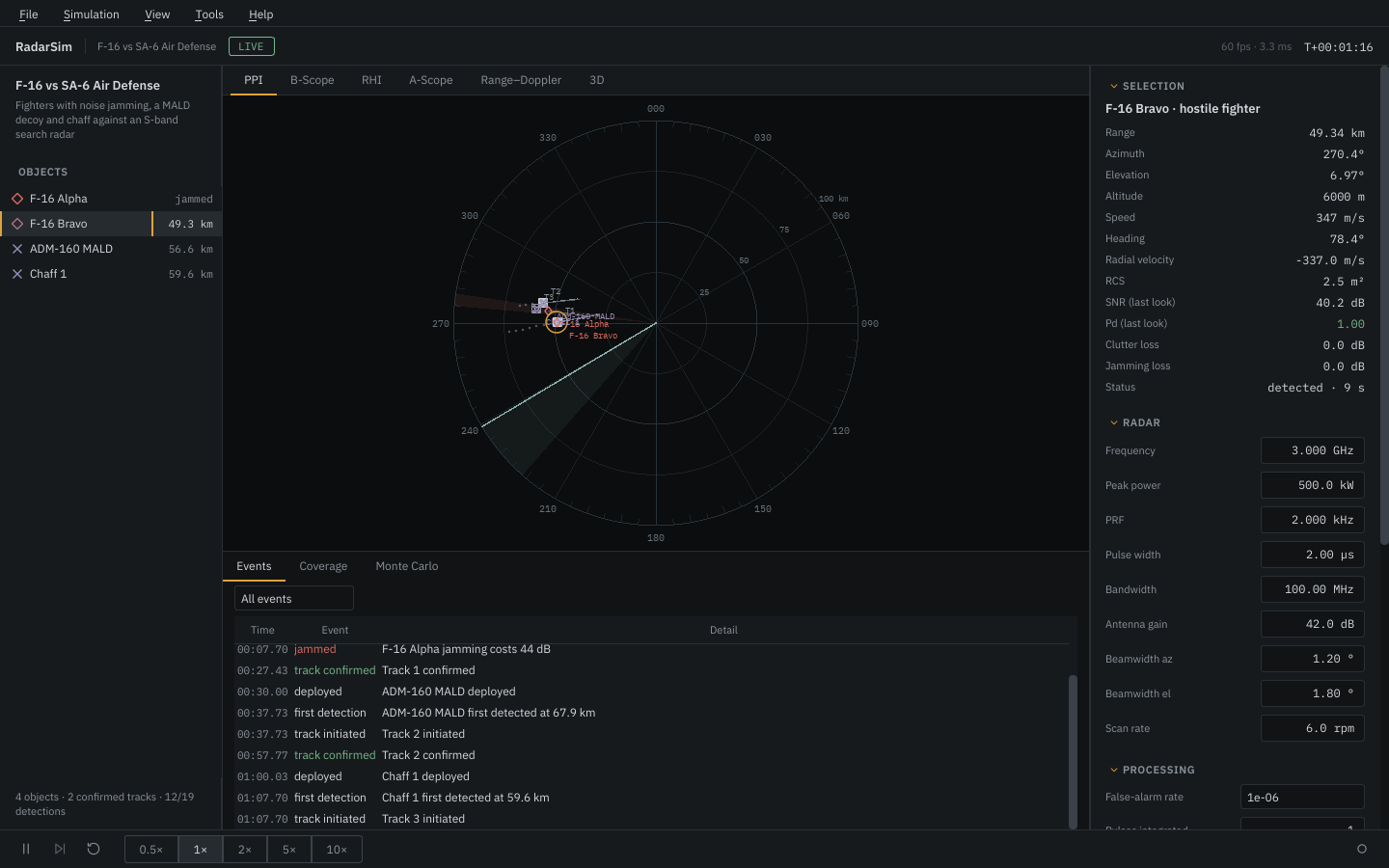
What it models
- Detection from the radar equation with pulse compression, Swerling 0–4 targets, non-coherent integration and CFAR loss. A target is looked at only when the beam passes over it, so detections and tracks arrive at the real revisit rate.
- Propagation: ITU-R P.676 gaseous absorption, ITU-R P.838 rain with a P.839 rain height, and line of sight over procedural or hand-placed terrain on a 4/3 Earth.
- Clutter: constant-γ land clutter, the Oh–Sarabandi–Ulaby bare-soil model, the NRL sea-clutter model, rain volume clutter, all entering through the elevation beam, plus an MTI canceller with the Skolnik improvement factor.
- Electronic attack: barrage and spot noise jamming with burn-through, DRFM range and velocity gate pull-off, chaff clouds and decoys released during the run.
- Tracking: track-while-scan with global nearest-neighbour assignment, χ² gating, two-point initiation and Kalman/EKF filters; monopulse angle measurement.
- Signal level: a coherent pulse-Doppler chain (LFM matched filter, MTI, windowed Doppler FFT, CA/GO/SO/OS CFAR) and range-Doppler SAR focusing.
Every model states its references and validity range in the code, and the test suite checks each one against closed-form results or published values (Validation).
Where to start
| If you want to | Go to |
|---|---|
| install it and open a scenario | Getting started |
| learn the window, scopes and shortcuts | The interface |
| see what each shipped scenario demonstrates | Built-in scenarios |
| write your own scenario | Writing scenarios |
| run batches without the GUI or use the library | Command line and Python |
| check an equation | Models |
Licence and citation
RadarSim is MIT-licensed. If you use it in published work, please cite it using
CITATION.cff in the repository.