Vehicle#
The Vehicle page describes the airframe that the Flight page flies, and has a separate calculator for multi-stage launch vehicles.
Design#
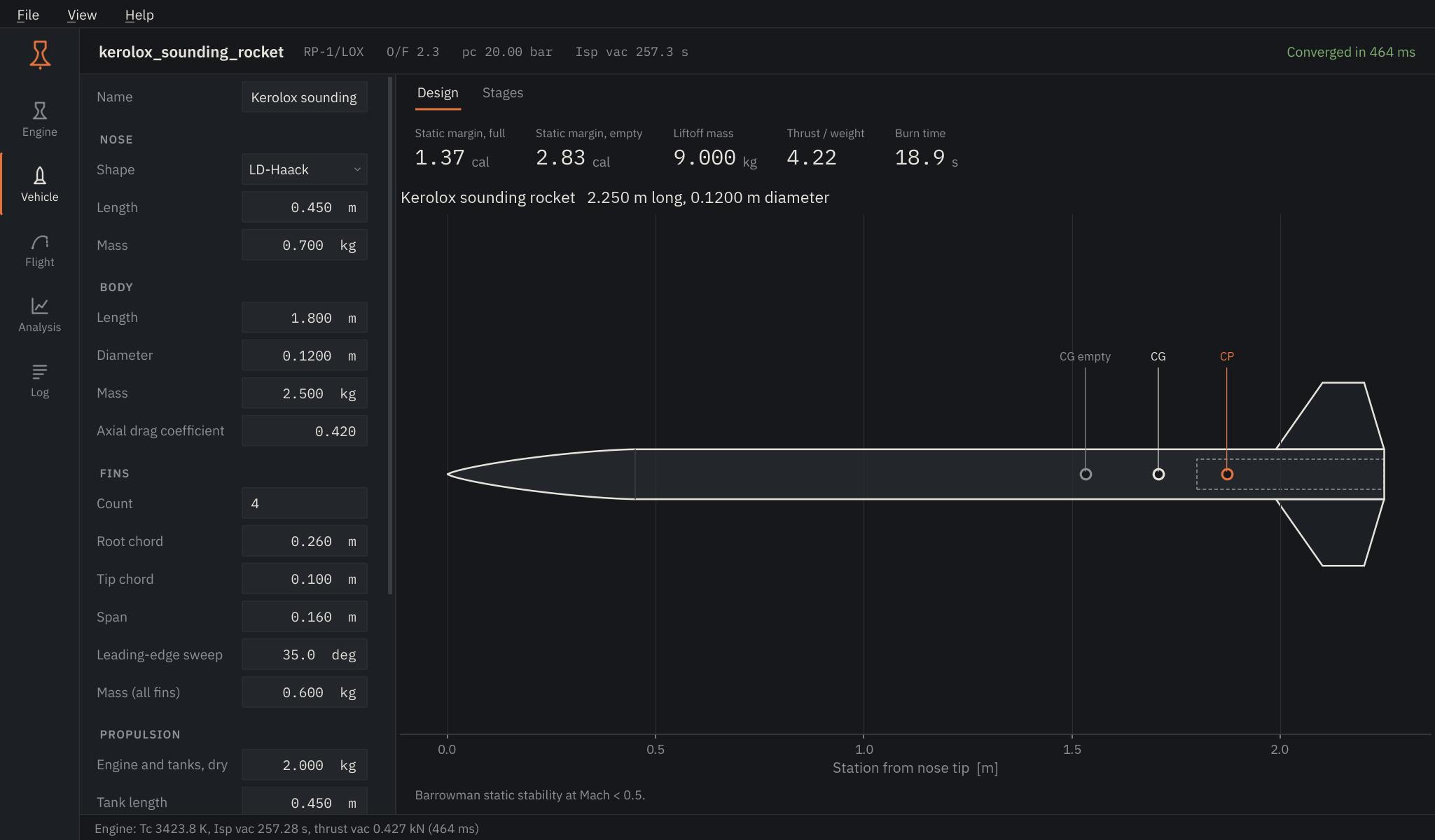
The drawing updates as you type. Circles mark the centre of gravity with full tanks, with empty tanks, and the centre of pressure.
| Input | Notes |
|---|---|
| Nose | Shape (conical, tangent ogive, elliptical, parabolic, LD-Haack), length and mass. The nose diameter follows the body. |
| Body | Length, diameter, mass and the axial drag coefficient used in flight. |
| Fins | Count, root and tip chord, span, leading-edge sweep and the mass of the whole set. |
| Propulsion | Dry mass of engine and tanks, tank length and propellant mass. The propellant is split into fuel and oxidizer at the engine's O/F. |
| Recovery | Main parachute diameter and drag coefficient, and with dual deployment a drogue that opens at apogee while the main waits for a set altitude. |
Static margin is the distance from CG to CP in body diameters (calibres), for full and empty tanks. Between 1 and 2 calibres is a common target. Below 1 the rocket may not recover from a gust; well above 2 it turns strongly into the wind. Thrust / weight uses the sea-level thrust of the last engine run, and burn time the propellant mass over the engine mass flow.
The centre of pressure comes from the Barrowman equations, which hold for small angles of attack at subsonic speed.
Stages#
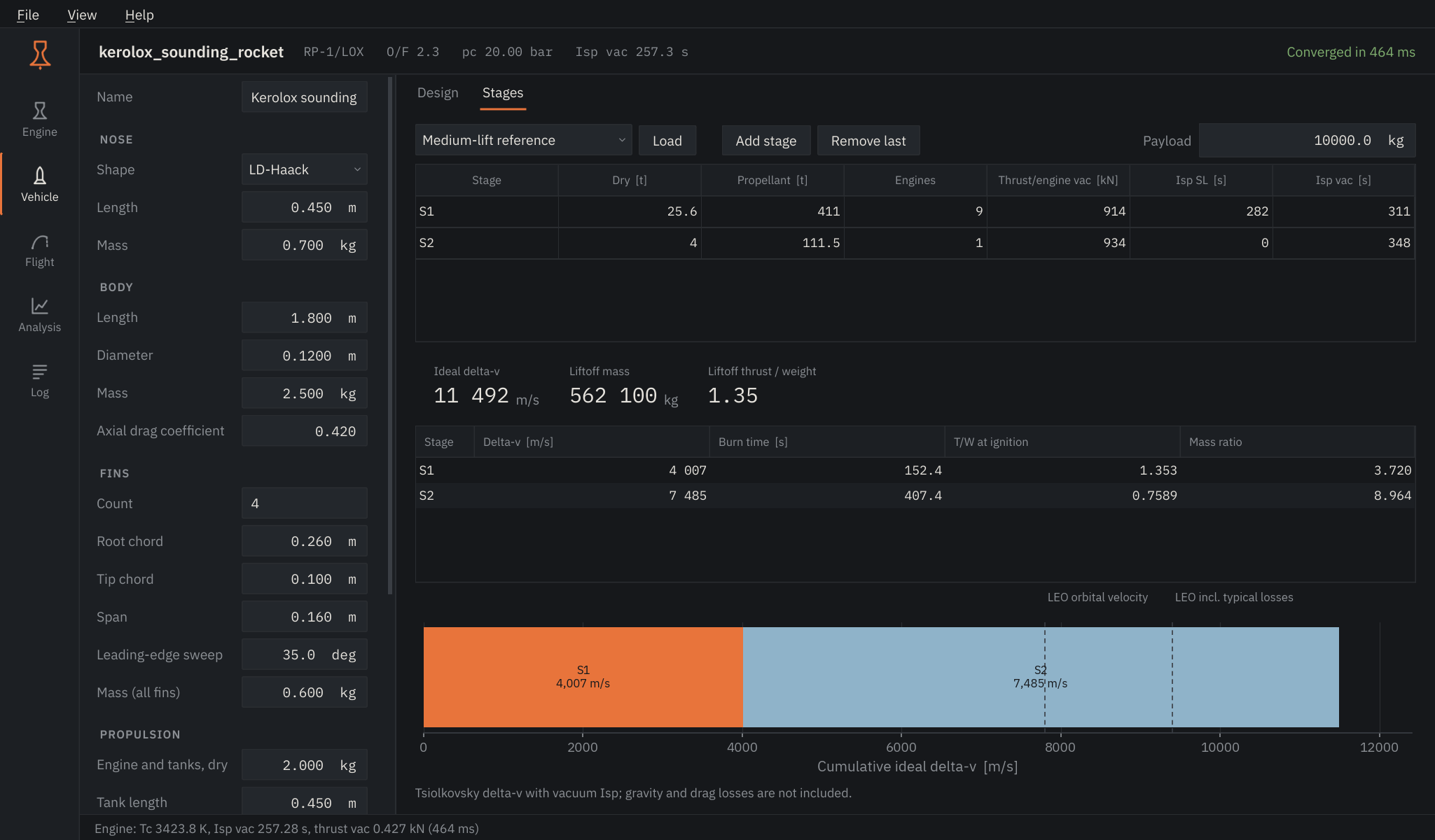
Each row is a stage, bottom first: dry and propellant mass, number of engines, vacuum thrust per engine, and sea-level and vacuum Isp. The breakdown gives each stage's ideal delta-v, burn time, thrust-to-weight at ignition and mass ratio; the bar shows the total against orbital velocity.
This is the rocket equation only. Gravity, drag and steering losses for a launch to low Earth orbit are typically 1.5-2 km/s, which is why the second reference line sits at 9.4 km/s.